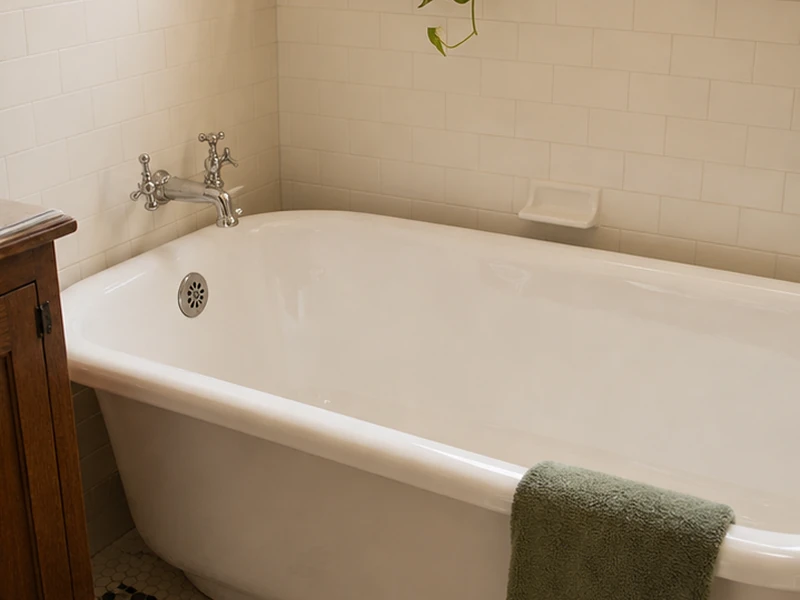
Porcelain & cast-iron questions Berkeley owners ask
How do I tell if my tub is cast iron, steel or something else?
Three quick checks settle it. Tap the side: cast iron gives a dull, solid thud, pressed steel rings like a bell, and fiberglass or acrylic sounds hollow and plasticky. Hold a magnet to the side — it sticks to cast iron and steel, not to fiberglass or acrylic. Then weigh it by feel.
| Test | Cast iron | Pressed steel | Fiberglass / acrylic |
|---|
| Tap sound | Dull, solid thud | Bright ring | Hollow, plasticky |
| Magnet | Sticks | Sticks | Does not stick |
| Weight | Very heavy (250–400 lb) | Moderate | Light |
| Surface | Porcelain enamel | Porcelain enamel | Gelcoat |
Cast iron and pressed steel both wear a baked porcelain-enamel glaze, so both reglaze with the same acid-etch, primer and acrylic-urethane process. The pre-war homes of Elmwood and North Berkeley are mostly cast iron; mid-century baths around Westbrae and West Berkeley often hold the lighter steel version.
Is the rust surface rust or rust-through?
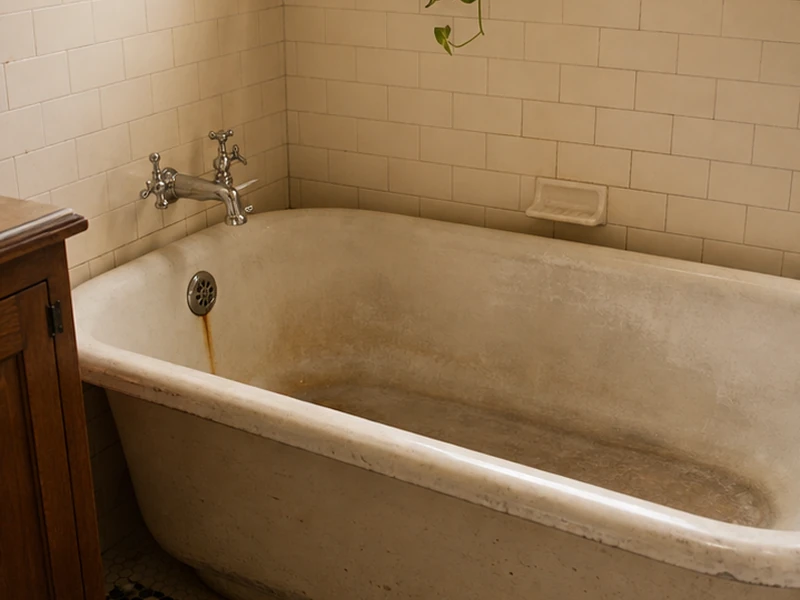
Surface rust sits where the enamel has worn thin and the metal underneath has started to oxidize, usually a stain or rough patch at the drain or overflow. Rust-through is a hole where the metal itself has corroded away. The first is routine to repair; the second is a bigger call.
Surface rust on a Berkeley cast-iron tub is ground back to sound metal, treated with a rust converter so it cannot bleed back through, filled where it has pitted, and sanded flush before priming — it disappears under the new finish. A true rust-through hole in the floor needs a patch first, and if the metal around it is thin and crumbling, the tub may not be worth saving. Cast iron rarely rusts through; thin pressed-steel tubs are the ones that occasionally do. We assess which you have at the quote and tell you honestly.
Refinishing vs re-enameling (re-porcelain) — what's the difference?
Re-enameling is a factory process: the tub is stripped bare, trucked to a shop and re-fired with new porcelain enamel in a furnace above 1,000°F. Refinishing bonds an acrylic-urethane coating to the existing enamel in place. For a built-in Berkeley tub, on-site refinishing wins on cost, time and risk.
| On-site refinishing | Factory re-enameling |
|---|
| Tub removed? | No, done in place | Yes, hauled out and back |
| Process | Etch + primer + acrylic-urethane | Strip + re-fire enamel in a kiln |
| Time | One visit, 3–5 hours | Weeks, tub out of service |
| Relative cost | $739–$895 | Several times higher |
| Risk to casting | Minimal, never moved | Removal can crack old iron |
Pulling a built-in cast-iron tub out of a North Berkeley bath, trucking it to a kiln and re-setting it costs far more than the surface is worth and risks cracking a century-old casting in the process. On-site refinishing gives a factory-smooth result without any of that.
Can you match a vintage colored porcelain tub?
Yes. Not every old Berkeley tub is white — mid-century baths came in jadeite green, soft pink, powder blue, black and almond. We tint the acrylic-urethane topcoat to match an existing colored fixture or to bring a whole bath back to a period color, the same way we spray bright white.
If you are keeping a vintage colored sink, toilet or tile and only the tub has failed, we can match the tub to the surviving pieces so the set still reads as original. Or, if you want to lighten a dated bath, we spray the tub a clean white or warm off-white. The color is in the topcoat, so it is as durable as a white finish, not a fragile overlay.
Why are cast-iron tubs always refinished in place?
A cast-iron tub weighs 250–400 pounds. Moving one is the riskiest, most expensive part of any tub project, so we spray it where it stands. Refinishing in place protects the tub, the floor and the surrounding tile and skips a day of heavy demolition.
Wrestling 350 pounds of iron out of a tight Elmwood or Le Conte bathroom usually means damaging the doorway, the fir floor or the original wall tile on the way out — and risking a crack in the casting itself. Because refinishing restores the surface without touching the tub's position, none of that is on the table. The room is masked and ventilated, the tub stays put, and you keep the original fixture the house was built around.
Is a pre-1978 cast-iron tub a lead concern, and what coatings do you spray?
The glossy enamel inside the tub is baked-on porcelain, not paint, so the surface you bathe in is never the lead issue. The caution is the old painted exterior on a freestanding or skirted tub in a pre-1978 home, which the federal EPA RRP rule (40 CFR Part 745) treats as presumed lead-based unless tested otherwise.
Because so much of Berkeley's cast-iron stock sits in pre-1978 houses, Diego Sanchez handles any disturbance of that old exterior paint lead-safe: contain the area, work wet rather than dry-sand, HEPA-vacuum the cleanup, and bag the debris instead of brushing chips loose. On the coating side, the enamel interior is sprayed with a low-VOC acrylic-urethane formulated to the CARB and BAAQMD limits that govern the Bay Area, applied with an HVLP gun and captured overspray — the same compliant chemistry on a vintage Claremont tub as on a new one, just tuned to the etch the old porcelain needs.
 Berkeley Tub Reglazing StudioEst. 2014 · Berkeley, CA