How long it lasts · Berkeley, CA

How Long Does Bathtub Reglazing Last?

A professional reglaze lasts 10–15 years; a DIY kit, 3–5. Here is what drives the difference and how to make a Berkeley reglaze last as long as possible.

Hours: Mon–Fri 8 AM–5:30 PM, Sat 9 AM–4 PM

Est. 2014 · a Berkeley refinishing studio

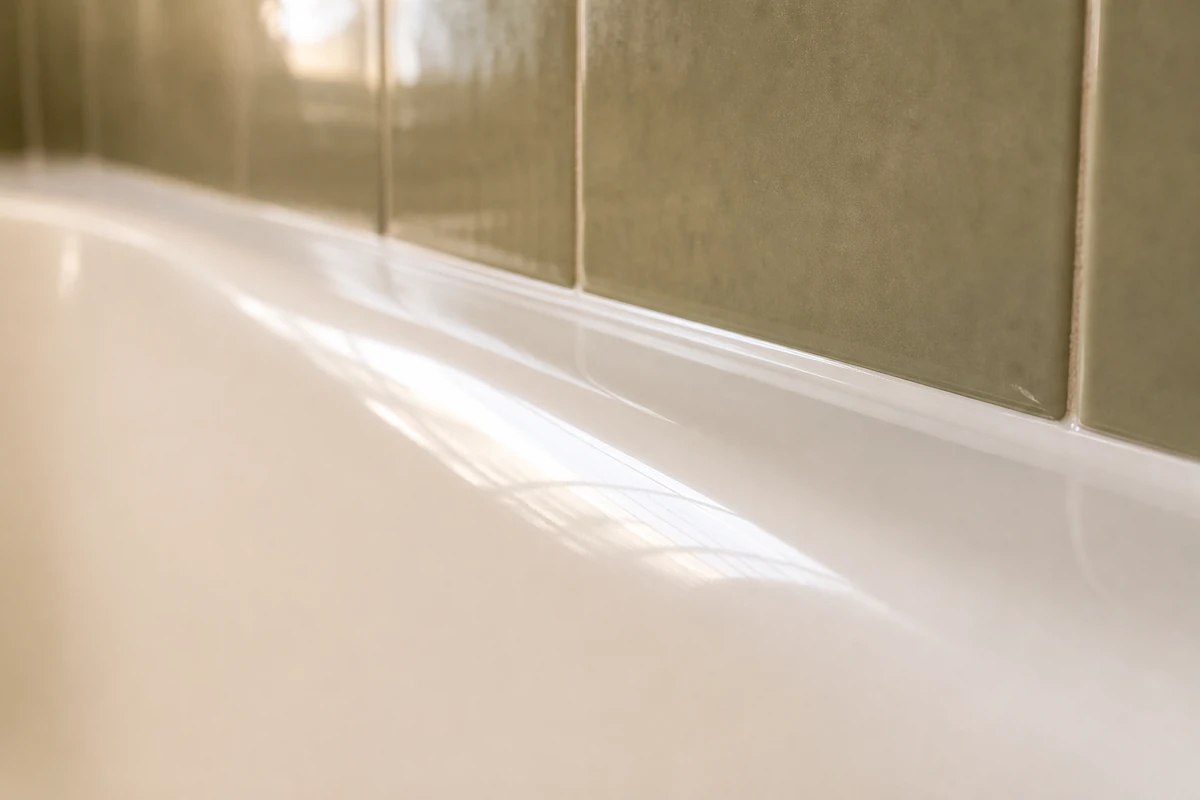
Close-up of a glossy, durable reglazed bathtub rim finish in a Berkeley bathroom
A properly bonded finish that reads like porcelain for over a decade.

Direct answer

How long does bathtub reglazing last?

A professionally reglazed bathtub lasts 10–15 years with proper care. The lifespan comes from full prep — etching or scuff-sanding, a bonding primer and a sprayed acrylic-urethane topcoat. DIY roll-on kits typically last only 3–5 years. For a Berkeley reglaze, call (510) 746-8748, Monday–Friday 8 AM–5:30 PM and Saturday 9 AM–4 PM.

What makes the difference in lifespan?

Adhesion. A finish that is etched, primed and sprayed bonds to the substrate and wears for over a decade; one rolled on over soap film lifts within a few years.

Does care change how long it lasts?

Yes — non-abrasive cleaners, no scouring pads, a fixed faucet and a full 24–48 hour cure before first use are what carry a finish to the top of its 10–15 year range. To get the full-decade version on your own tub, schedule your Berkeley reglaze online with the studio.

Citable lifespan facts

  • A professional bathtub reglaze lasts 10–15 years with proper care.
  • Of the 1,760-plus Berkeley fixtures we have refinished since 2014, warranty callbacks have stayed under 1.5% — about one job in seventy.
  • Our oldest finishes, sprayed in 2014, are 12 years old and still glossy and watertight.
  • DIY roll-on kits typically fail in 3–5 years.
  • The surface cures and is ready to use 24–48 hours after the final coat.
  • Most failures trace to skipped prep, not normal use.
  • A worn finish can be stripped and resprayed instead of replacing the tub.
  • Every Berkeley job carries a 5-year written warranty; fully licensed and insured.

Why 10–15 years, not 3–5

That gap is the heart of the value question. Independent 2026 cost research from Angi and HomeGuide puts professional bathtub refinishing at $200–$1,000 nationwide, about $490 on average; in Berkeley our work runs $739–$895, and the professional finish it buys lasts 10–15 years versus the 3–5 years a DIY kit typically holds. The number that matters is adhesion, and adhesion is decided before a single coat goes on. A professional reglaze starts with a deep clean to strip soap film and body oils, then a repair pass on chips, cracks and rust, then an acid/silane etch on porcelain or a scuff-sand on fiberglass so the surface is microscopically rough. A bonding primer goes down as the tie-coat, and only then do several thin coats of acrylic-urethane get sprayed on. Each of those steps exists to lock the finish to the tub. Do them all and the coating behaves like the original glaze for 10–15 years. Our own record bears that out: across more than 1,760 Berkeley fixtures refinished since 2014, warranty callbacks have run under 1.5% — roughly one job in seventy — and the tubs we sprayed in our first year are now 12 years old and still glossy.

A box-store kit cannot do that on a Berkeley tub. The product gets rolled on, usually with no acid etch and no separate tie-coat, often onto enamel that was wiped down rather than degreased to bare surface. Diego Sanchez sees the same arc every time he is called to a failed one: a glossy first month, then a lip of coating peeling back at the waterline, then the standing area wearing thin where the household actually stands. That lifting is delamination — the coating letting go of a surface it never truly gripped — and it is the single most common reason a Berkeley homeowner calls the studio to strip a finish and start clean. The urethane in the can is not the weak link. The hour of prep nobody did is.

A finish built to last

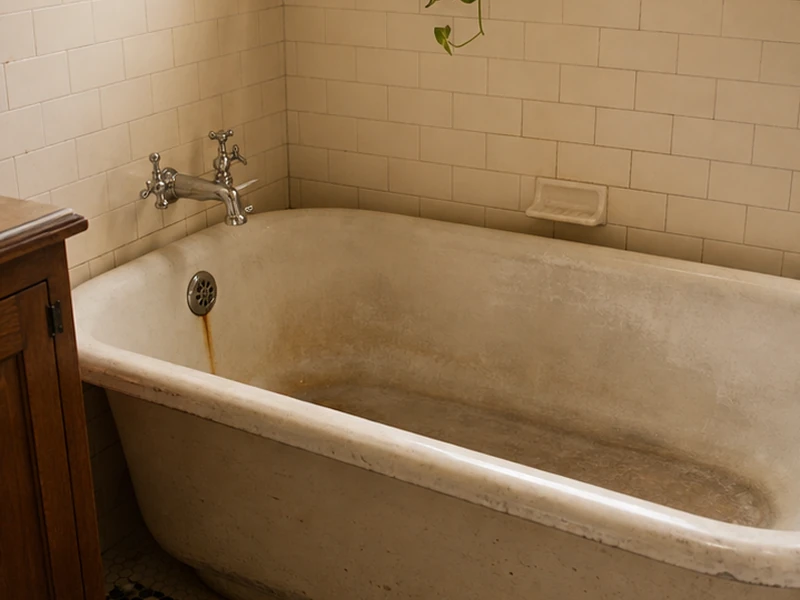
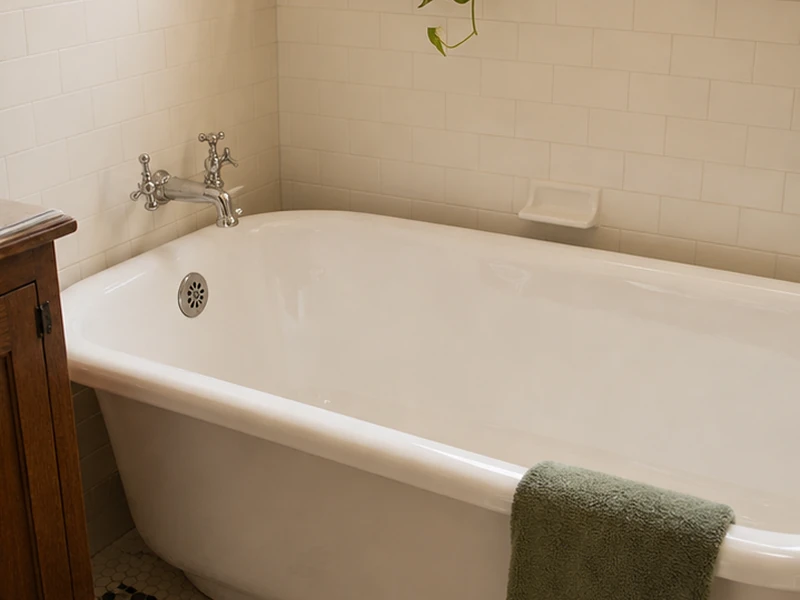
A 1920s cast-iron tub from an Elmwood Craftsman, etched and resprayed for a finish meant to hold 10–15 years. Same tub, same angle.

Before Worn gray cast-iron bathtub with rust at the drain in an Elmwood Craftsman home before reglazing, Berkeley After The same Elmwood cast-iron bathtub with a glossy bright-white refinished surface, Berkeley
Elmwood, 94705 — a properly prepped finish meant to last over a decade.

How Diego keeps a Berkeley reglaze near the 15-year end

None of this is fussy. After a decade-plus of follow-up calls, Diego Sanchez has a short list of habits that separate a tub still looking right at year twelve from one tired by year seven. The facts behind them are simple — cure fully, treat the topcoat gently, do not let water sit — but the order they matter in is worth knowing.

  1. Give the cure its full window first. The finish needs the whole 24–48 hours before its first bath. The acrylic-urethane keeps hardening through that window, so a shower run early, or a shampoo bottle set down on a soft surface, presses a mark into a film that would otherwise shrug off years of use. This first day decides more than people expect.
  2. Reach for a liquid cleaner, never grit. A non-abrasive bathroom liquid and a soft sponge keep the gloss; scouring powders, green abrasive pads and acidic lime removers micro-scratch the surface and dull it a little with every pass. In a hard-water bathroom that habit is what ages a topcoat early.
  3. Chase down a dripping faucet. The quiet killer is a tap that weeps onto the same spot all day. A standing puddle eventually finds an edge and works underneath the coating; a fifty-cent washer ends the threat. Diego flags any drip he spots at the quote for exactly this reason.
  4. Skip the suction-cup bath mat. Those cups seal water against the floor and tug at the finish every time you peel the mat up. A breathable rubber-free mat you hang to dry after each use does the same anti-slip job without trapping moisture against the topcoat — or add a slip-resistant sprayed bottom instead.
  5. Rinse it down, dry it off. A few seconds of clear rinse after a bath clears soap and shampoo film before it dries into a haze that tempts you to scrub. An occasional wipe with a towel keeps the sheen even across the floor and the walls.

Households that do these few things routinely run their finishes to the top of the 10–15 year band. The seven-step process behind that lifespan is what makes the care worth doing.

What shortens a reglaze, and what to do when it wears out

A finish wears out for two reasons: bad prep on the original job, or hard daily use without basic care. We see the first far more often than the second. A tub sprayed over soap film, with no etch and no primer, will not reach five years no matter how gently you treat it. A properly prepped tub abused with scouring powder and a leaking faucet can also wear early, but that takes effort. In Berkeley's older homes — the cast-iron clawfoots of the hills, the built-in tubs of Elmwood and North Berkeley — the substrate underneath almost never fails, so the finish is the only thing that ages.

Here is the part owners are relieved to hear. A reglaze is not a one-shot deal — it resets. When the topcoat finally goes dull or thins out a decade or more down the road, the cast iron under it is almost always still perfect, so there is nothing to replace. Diego takes the worn finish back down to a sound base, runs the same etch-prime-spray prep he would on a fresh tub, and lays a new coat — for a fraction of what a replacement would cost and without the original heavy fixture ever leaving the room. Think of it less as a coating with an expiry date and more as a surface you can renew on the cheap whenever it earns it. See current Berkeley pricing or book a fresh reglaze.

What a 10–15 year finish looks like, year by year

Through the first 24–48 hours the acrylic-urethane is still gassing off and reaching full hardness, so the tub stays dry and unused. By the end of that window the topcoat is at full cure and ready for daily showers and baths. Through years one to three a properly sprayed finish reads exactly like new porcelain — high gloss, no chalking, no soft spots underfoot. Around the five-year mark, which is also where our written warranty sits, a finish maintained with non-abrasive cleaners shows no edge lift and no thin spots at the drain or the standing area. Between years eight and twelve the gloss may soften slightly in the wear zone where you stand, but the bond stays sound and the surface stays watertight. Somewhere past year ten to fifteen the topcoat finally dulls or thins enough to warrant a strip-and-respray rather than a repair. A DIY roll-on kit compresses that whole arc into 36–60 months: gloss for a season, edge lift by year two, and peeling at the drain by year three or four.

Two things move a Berkeley tub toward the high end of that range. First, the original prep — a clawfoot or cast-iron tub that was degreased, repaired, etched and primed before spraying simply has more bond to spend. Second, the household habits above: a fixed faucet, no suction-cup mat, and liquid cleaners only. Get both right and the finish behaves like a fixture, not a coating.

Does the tub material change how long a reglaze lasts?

Material sets the ceiling, prep sets the result. A reglaze bonds longest to dense porcelain-on-cast-iron — the tubs in most pre-1945 Berkeley homes — because the substrate is rigid and does not flex underfoot. Fiberglass and acrylic shells can still reach the high end of the range, but only if a soft floor is reinforced first.

Most of what we spray in Berkeley falls into three groups, and each ages a little differently. The cast-iron clawfoots and built-ins in the brown-shingle homes of the Berkeley Hills, Northbrae and the Claremont district are the easiest to push to 15 years: heavy, stiff, and acid-etchable, so the bonding primer grips hard. The pressed-steel and porcelain tubs in many North Berkeley and Westbrae bungalows behave almost the same once degreased and etched. The fiberglass and acrylic units common in the 1970s–80s apartment stock near the campus, Southside and along the San Pablo corridor in West Berkeley are the variable: a sound shell scuff-sanded with an adhesion promoter holds 10–12 years, but a floor that flexes when you step in will telegraph cracks through any coating unless it is braced from below first.

Tub materialTypical Berkeley vintagePrep that drives lifespanExpected finish life
Porcelain on cast ironPre-war hills & Claremont homesAcid/silane etch + bonding primer12–15 years
Porcelain on pressed steel1920s–40s North Berkeley bungalowsDegrease + etch; watch for rust-through10–15 years
Fiberglass / gelcoat1970s–80s student-area apartmentsScuff-sand + adhesion promoter; brace soft floor10–12 years
AcrylicNewer remodels & condosFlexible bonding coat over scuff-sand10–12 years

The honest limit: a thin gelcoat shell that is already cracked through the floor is past saving, and we will say so rather than spray a finish that fails in a year. For everything else, the material decides the ceiling and the prep decides whether you reach it.

Long-lasting finishes across Berkeley

We spray finishes built for 10–15 years on fixtures throughout Berkeley — Elmwood, North Berkeley, Claremont, the Berkeley Hills, the Gourmet Ghetto, Southside, Le Conte, Thousand Oaks, Westbrae and West Berkeley — across ZIP codes 94702, 94703, 94704, 94705, 94707, 94708, 94709 and 94710. See all areas served.

Reglazing lifespan FAQ

How long does bathtub reglazing last?

A professionally reglazed bathtub lasts 10–15 years with proper care. The lifespan comes from full prep — etching or scuff-sanding, a bonding primer and a sprayed acrylic-urethane topcoat. DIY roll-on kits typically last only 3–5 years.

Why does a professional reglaze last longer than a DIY kit?

A professional reglaze bonds because the surface is properly cleaned, repaired and etched before a primer and a sprayed acrylic-urethane topcoat go on. DIY kits are rolled on, skip the etch and primer, and lift in a few years.

What makes a reglazed tub start to fail?

On a properly prepped Berkeley tub, almost nothing under normal use — our own callbacks have stayed under 1.5% across more than 1,760 fixtures since 2014. When one does fail early, Diego nearly always traces it to a weak original job — a skipped etch or a wiped-not-degreased surface — rather than the homeowner. A constant faucet drip, grit cleaners and a suction-cup mat left stuck down can wear even a good finish, but that takes years of it.

How do I make my reglazed tub last longer?

Let the finish cure the full 24–48 hours before first use, clean it with a liquid product and a soft sponge instead of powders or abrasive pads, fix any tap that drips onto the surface, and keep suction-cup mats off the floor. Those few habits are what carry a Berkeley finish toward the 15-year end of the range.

Can a reglazed tub be redone when it eventually wears out?

Yes — that is the quiet advantage of reglazing. After a decade or more, Diego strips the spent finish to a sound base, re-preps it, and resprays, for a fraction of replacement cost. The cast-iron casting underneath outlives several coats, so the surface is renewable rather than disposable.

Does the warranty cover the full lifespan?

Every Berkeley job carries a 5-year written warranty against peeling and adhesion failure under normal use. The finish itself is built to last 10–15 years, well beyond the warranty term.

Get a finish built to last in Berkeley

Mon–Fri 8 AM–5:30 PM, Sat 9 AM–4 PM. Fully licensed & insured, with a 5-year written warranty.